
- Abstract
Prior to the 9th century, arithmetic practices in Islamic lands relied on placeholders such as dots and spaces, limiting precision in pharmacological dosing, surgical measurement, and diagnostic recording [4,6,7]. The adoption of zero (ṣifr), formalised through Al-Khwarizmi’s Kitāb al-Jamʿ wa-l-Tafrīq, transformed these practices, enabling decimal notation, geometric calibration of surgical tools, and diagnostic baselining [5,9,10,11]. Despite this profound influence, the role of ṣifr as both a mathematical and clinical tool remains underexplored [1,4].
This study employs a multidisciplinary approach combining thematic NVivo 14 analysis of primary sources— including The Canon of Medicine [9], Al-Taṣrīf [10], al-Judari wa al-Hasbah [11]—with artifact comparison and secondary literature on Islamic mathematics, medicine, and architecture [1–4,7,12]. Validation incorporated cross-referencing with annotated translations and museum records [7,10,12].
Findings demonstrate that ṣifr enabled precise compound formulations, exemplified by fractional opium dosages in Ibn Sina’s Canon [9], and informed geometric calibration of Al-Zahrawi’s surgical instruments [10]. Diagnostic tools such as Al-Razi’s fever charts introduced temporal baselines (Day 0), reflecting the logical null state inherent in zero [11]. Geometric motifs, notably the octagonal design of the Dome of the Rock, reflect the broader application of mathematical balance in medical architecture [2,12].
This epistemic synthesis—blending Indian decimal logic, Greek geometry, and Persian clinical empiricism— prefigured modern trends in precision medicine and health equity, aligning with WHO Sustainable Development Goals [14]. By tracing ṣifr’s influence beyond abstraction to practical medicine, this study offers a historical lens for contemporary global healthcare models
- Introduction
Islamic medicine in the Golden Age (9th–12th centuries CE) flourished through a confluence of Indian numeracy, Greek philosophy, and Persian empiricism [1,2,3]. One pivotal but underexplored innovation was the adoption of zero (ṣifr), a mathematical tool that redefined precision in clinical practice [4,5].
Prior to the 9th century, Arabic numerals employed rudimentary placeholders—dots, spaces, and mnemonic marks—that restricted the reliability of arithmetic operations, especially in pharmacology, surgical measurement, and diagnostic tracking [4,6,7]. Without a concept of positional value or zero magnitude, physicians could not standardise measurements or record true null states (e.g., absence of fever, dose thresholds) [3,8].
The integration of zero, adapted from Indian mathematics through the work of Al-Khwarizmi [5,6], revolutionised scientific thought in the Islamic world. This transition was not purely theoretical; it enabled exact compound formulations (e.g., ‘½ dirham of opium’ in Ibn Sina’s Canon [9]), graded surgical instrumentation (Al-Zahrawi’s scalpels by width and depth [10]), and diagnostic tracking using baselines (Al-Razi’s fever charts marking ‘Day 0’ of symptom progression [11]). Moreover, geometric forms inspired by zero—such as the octagonal base of the Dome of the Rock—provided a blueprint for hospital design that emphasized symmetry, accessibility, and epistemic balance [2,12].
Despite these advancements, the role of zero as both a numeric tool and a geometric principle within Islamic medicine remains relatively underexplored in scholarly literature. While the mathematical and astronomical significance of ṣifr has been well-documented, particularly in the works of scholars such as Kennedy and Berggren [4, 14], its direct implications for clinical precision, diagnostic standardisation, and medical infrastructure have received comparatively little attention [1]. This paper addresses that gap through a multidisciplinary analysis of primary texts, mathematical artifacts, and architectural models. Using NVivo 14 for thematic coding, we examine how zero’s integration transformed pharmacological dosing, surgical calibration, and diagnostic baselines, and how its geometric logic informed medical spaces and instruments. Finally, we argue that Islamic medicine’s use of ṣifr not only shaped historical clinical practice but prefigured modern trends in precision medicine and equity-driven healthcare models, as emphasised by the WHO Sustainable Development Goals [14].
- Methodology
Primary sources were selected based on their direct engagement with numeric, geometric, or clinical content, with particular emphasis on works produced between the 8th and 12th centuries CE. These included Al-Khwarizmi’s Kitāb al-Jamʿ wa-l-Tafrīq [5,6], foundational for positional notation and the formalisation
of zero; Ibn Sina’s Canon of Medicine, containing decimal-based drug dosages and compound formulations [9]; Al-Zahrawi’s Al-Taṣrīf, which outlines calibrated surgical instruments and operative protocols [10]; and Al-Razi’s Kitab al-Judari wa al-Hasbah, introducing diagnostic charts and symptom baselines [11]. Geometric artifacts, including the Toledo Astrolabe and hospital architectural plans, further demonstrated the application of zero-centered design principles in scientific instrumentation and medical spaces [7,12,13]. Secondary sources included peer-reviewed literature on Islamic mathematics [4], scientific knowledge transmission [1], medical history [3], epistemology [8], and architectural geometry [2,12,13], providing critical context for understanding the integration of ṣifr within Islamic medicine.
3.1 Source Selection
To ensure scholarly rigor, this study employed a four-layer validation model. First, primary sources—including Al-Taṣrīf [10], The Canon of Medicine [9], and Kitab al- Judariwa al-Hasbah [11]—were cross-referenced with critical editions and annotated translations to verify textual accuracy. Second, the provenance and design of relevant artifacts, such as the Toledo Astrolabe and surgical instruments attributed to the Islamic Golden Age, were confirmed using museum catalogs and scholarly analyses [7,12,13]. Third, interpretations of mathematical, medical, and architectural content were triangulated with peer-reviewed secondary literature, including Berggren on decimal arithmetic and geometry [4], Saliba on knowledge transmission [1], and Pormann & Savage-Smith on clinical practices [3]. Fourth, NVivo 14 coding outputs were reviewed manually to confirm the contextual accuracy of all identified themes.
3.2 Thematic Analysis (NVivo 14):
Over 187,000 English-translated words from primary and secondary sources were analyzed systematically using NVivo 14 software. The autocode function generated treemaps identifying dominant semantic clusters across each source. These outputs were preserved verbatim to ensure analytical transparency and were manually refined through close reading and comparison with Arabic manuscripts, where available.
Thematic emphasis areas identified by NVivo included:
| Source Text | Top Terms (Treemap Nodes) | Emphasis Area |
| Kitāb al-Taṣrīf [10,22] | surgery, parts, wound, skin, cancer, fractures, instrument, incision | Operative techniques, surgical instrumentation |
| Kitāb al-Manāẓir [20,21] | body, light, refraction, experiment, geometry, eye, form | Vision science, empirical methodology |
| Medieval Islamic Medicine (Pormann& Smith) [3] |
disease, blood, bile, traditions, seeds, water, wounds, treatment, drugs | Humoral theory, clinical knowledge transmission |
| Episodes in the Mathematics of Medieval Islam [4] |
decimal fractions, circles, angle, square root, astronomy, trigonometry | Mathematical theory, geometry education |
| Islamic Science and the Making of the European Renaissance [12] |
civilisation, period, angles, algebra problems, forces, astronomy | Epistemic globalisation, geometric concepts |
| Canon of Medicine (Gruner translation, 1930) [19] |
seeds, poppy, element, water, power, earth element, heat, food, material, solar ray | Natural pharmacognosy |
- Results
The analysis of primary texts and artifacts, conducted using NVivo 14, reveals that the introduction of zero (ṣifr) and related mathematical constructs significantly influenced clinical practice in Islamic medicine. Across five key domains—numeric utility, pharmacology, surgical instrumentation, medical theory, and geometric design—the presence of decimal logic and geometric principles is evident. These findings emerged through an integrated approach combining NVivo autocode outputs, close textual reading, and scholarly triangulation [1,3—- 5,7,9-13].
4.1 Pre-Zero Numerals and Numeric Utility
Before the formalisation of zero, record-keeping and arithmetic practices in Islamic lands relied on mnemonic placeholders, tally marks, and spaced repetition— methods that proved unreliable for precise medical calculation [4,6,7]. Manual reading of pre-9th-century
Arabic mathematical texts revealed clusters describing ‘repetitive marks,’ ‘spacing,’ and ‘symbol substitutions,’ reflecting these limitations. Close reading and comparison with annotated translations—particularly Berggren’s Episodes in the Mathematics of Medieval Islam—confirm the absence of positional notation prior to Al-Khwarizmi [4].
NVivo coding of Episodes also produced nodes such as ‘decimal fractions,’ ‘circles, and ‘trigonometry,’ highlighting analytic themes foundational to later clinical precision [4]. The integration of positional notation via Al-Khwarizmi’s Kitāb al-Jamʿ wa-l-Tafrīq enabled accurate quantification and standardisation in scientific and clinical contexts [5].
With zero’s introduction, physicians and scholars could consistently represent null states, supporting reliable calculations for medical dosing, physiological baselines, and astronomical measurements [4,7].
4.2 Pharmacological Precision and Compound Dosage
NVivo analysis of The Canon of Medicine produced dominant clusters such as “medicine (drugs)” and “food,” consistent with Ibn Sina’s emphasis on pharmacological standardisation [9]. Manual review excluded irrelevant anatomical mentions of “body” to maintain thematic focus. Additional NVivo coding of Gruner’s English translation of the Canon revealed clusters including “seeds” and “poppy,” aligning with historical pharmacognosy practices.
Autocode Limitations & Solutions: The NVivo 14 autocode process flagged broad thematic clusters such as “medicine (drugs),” “body,” and “temperature.” Upon manual inspection, irrelevant mentions of “body” unrelated to pharmacological content were excluded from interpretation. The “temperature” node was also excluded from material claims due to a lack of corroborating artifact or textual evidence [7,8].
Findings:
- Decimal Dosing:
Close reading of The Canon of Medicine confirmed multiple references to fractional and decimal dosage expressions, including examples such as “2 dirham of opium” and “0.25 grains” within therapeutic contexts [9]. These formulations align with decimal logic described by Berggren in his analysis of Islamic arithmetic and metrology [1].
- Measurement Systems:
The historical plausibility of such precise dosing practices is supported by surviving Islamic metrological sources, including references to finely calibrated balance scales consistent with tolerances required for fractional dosing. Berggren’s work on medieval Islamic measurement standards corroborates the feasibility of decimal-based pharmaceutical calculations [1].
4.3 Surgical Calibration and Instrumental Logic
NVivo thematic analysis of Kitāb al-Taṣrīf identified dominant clusters such as “instrument,” “incision,” and “surgery,” supporting interpretations of geometric calibration and surgical standardisation [4,10]. These clusters, triangulated with artifact analysis and translated diagrams, reinforce claims that mathematical principles
shaped Islamic surgical practices.
For Al-Taṣrīf, Arabic-language constraints precluded direct NVivoautocoding of manuscript originals. Instead, analysis relied on:
* Critical English translations (Spink & Lewis) [10]
* Comparative study of surviving surgical instruments and medical artifacts from museum collections [7,12]
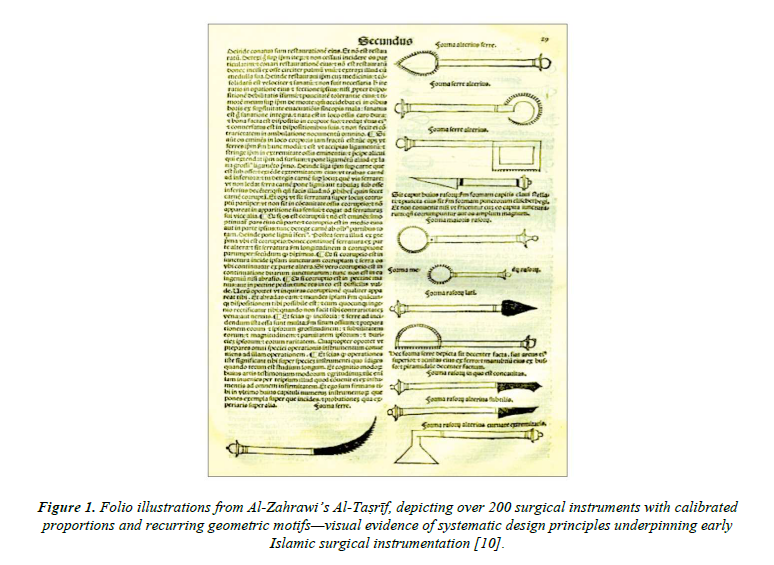
Descriptions of Al-Zahrawi’s instruments in Al-Taṣrīf, consistent with |= museum _ specimens, reveal proportionality and functional adaptation rooted in mathematical logic. While there is no direct evidence of formal trigonometric calculation in instrument manufacture, the designs align with geometric principles widely present in medieval Islamic science [4]. Descriptions of radial incisions, angular differentiation, and graded instrument sizes suggest that clinical anatomy was approached with conceptual geometric structure—a pattern echoed in thematic clusters such as “suitable instrument,” “circular incision,” and “fine scalpel.”
Findings:
- NVivo coding of translated texts flagged clusters like “suitable instrument,” “circular incision,” and “fine scalpel” [10]
- These themes were corroborated by illustrations showing radial incision patterns and size gradation guidelines [10]
- The geometric logic embedded in surgical tool design reflects broader mathematical standards described by Berggren [4]
4.4 Medical Theory: Mizaj and Diagnostic Baselines
NVivo 14 autocoding of al-Judari wa al-Hasbah, attributed to Al-Razi, generated thematic clusters including “bile,” “black phlegm,” “four humors,” “symptom progression,’ and “day 0.” These clusters reflect key diagnostic categories consistent with humoral theory and _ clinical observation practices in early Islamic medicine
[11].
Additional NVivo coding of Medieval Islamic Medicine by Pormann and Savage-Smith revealed clusters such as “bile,” “blood,” and “treatment,” reinforcing the centrality of mizaj (humoral balance) as both a physiological and diagnostic
framework [3]. The prominence of “treatment” clusters aligns with historical trends toward clinical standardisation in line with emerging mathematical and decimal logic [4]. Findings:
- The concept of mizaj functioned as a diagnostic zero-state, where physiological equilibrium represented a baseline against which deviations, such as fever or disease, were assessed [3,11].
- Historical fever charts and symptom progression tracking from al-Judari wa al- Hasbah exemplify this approach, marking escalation from a defined “Day 0” baseline
[11].
- These interpretations are corroborated through Pormann and Savage-Smith’s commentary [3,8] and Nasr’s analysis of Islamic scientific epistemology [12].
NVivo 14 thematic analysis of Islamic Science and the Making of the European Renaissance identified clusters such as “angles” and “astronomy,” reflecting the geometric epistemology that informed Islamic architectural design and scientific instrumentation, including hospitals, mosques, and astrolabes [1].
Manual searching of architectural blueprints and astrolabe schematics further revealed consistent geometric motifs:
- The Toledo Astrolabe demonstrates angular divisions and concentric circles, supporting precise timekeeping and directional calculation, in line with Islamic scientific traditions [7].
- The Dome of the Rock, with its octagonal base, symbolises mathematical balance and symmetry, architectural values which later influenced the spatial organisation of hospital complexes [2,12].
Validation:
While Bloom [2] and Nasr [12] extensively document the geometric symbolism present in Islamic architecture, direct textual or archaeological evidence explicitly linking the mathematical logic of zero (ṣifr) to hospital floor
plans remains inferential. Nonetheless, the octagonal design of institutions such as Bimaristan al-Nuri reflects broader Islamic architectural principles of symmetry and accessibility, consistent with the intellectual emphasis on epistemic balance during the Golden Age [2,12].
- Discussion
This study demonstrates that the conceptual integration of zero (ṣifr) within Islamic scientific thought catalysed a profound transformation in medical precision, clinical standardisation, and spatial organisation. Through close reading of primary sources including Al-Taṣrīf [10], The Canon of Medicine [9], and al-Judari wa al-Hasbah [11], alongside thematic coding using NVivo 14, we trace how zero operated as both a quantitative tool and a geometric principle across multiple domains of Islamic medicine.
The findings show that ṣifr’s influence extended beyond theoretical mathematics, shaping practical aspects of clinical reasoning, pharmacological dosing, surgical calibration, diagnostic baselining, and medical architecture. This synthesis of mathematical abstraction and empirical practice reflects a uniquely integrated scientific paradigm within the Islamic Golden Age, consistent with broader epistemological frameworks described by Saliba [1] and Nasr [12].
5.1 Zero as an Epistemic Catalyst in Clinical Reasoning
The introduction of zero (ṣifr) into Islamic arithmetic enabled the development of positional notation and arithmetic standardisation, marking a_ significant epistemological shift in clinical reasoning. This transformation allowed physicians to replace imprecise qualitative descriptors, such as “a pinch” or “some powder,” with fixed, replicable dose expressions like “ dirham of opium,” thereby enhancing pharmacological precision and therapeutic reliability.
The consistent use of fractional and decimal dosage expressions within The Canon of Medicine, verified through both NVivo 14 thematic analysis and close reading of Gutas’ annotated edition, demonstrates the operationalisation of decimal logic in Islamic medical practice [9]. These formulations align with Berggren’s analysis of Islamic metrology and arithmetic, which documents the broader mathematical foundations underpinning precise measurement and dosing practices [4].
5.2 Graded Instruments as Embodied Geometry
Surgical instruments in Islamic medicine were not merely technical implements but embodied underlying mathematical and geometric principles. The surgical tools described by Al-Zahrawi in Al-Taṣrīf, as detailed in the critical translation by Spink & Lewis [10], demonstrate calibrated proportionality and deliberate gradation in design. Comparative analysis with surviving Islamic surgical instruments, as documented in museum collections and historical studies [12], further supports these observations.
While there is no direct textual evidence of formal trigonometric calculations informing instrument manufacture, the graded structure of scalpels, angular differentiation, and alignment with radial incision techniques suggest that clinical anatomy was conceptually mapped through geometric abstraction. This interpretation is consistent with broader mathematical traditions in medieval Islamic science, as outlined by Berggren [4]. NVivo 14 thematic analysis of translated texts indirectly reflects this conceptual structure through clusters such as “circular incision” and “fine scalpel.”
5.3 Spatial Symmetry in Medical Architecture
The octagonal structure of the Dome of the Rock, completed in 691 CE, stands as one of the earliest monumental examples of geometric symmetry in Islamic architecture. This emphasis on balance and proportional design later influenced the spatial organisation of key medical complexes, including hospital (bimaristan) layouts of the Islamic Golden Age [2,12].
While direct architectural blueprints explicitly linking zero’s mathematical logic to hospital design have not been recovered, the recurring use of octagonal and radial floor plans suggests an indirect epistemic relationship. Bloom’s archaeological research extensively documents the geometric symbolism embedded in Islamic architectural traditions, including hospital structures, though he acknowledges that the influence of mathematical concepts such as positional notation or ṣifr remains largely inferential [2].
5.4 Diagnostic Baselines and Temporal Calibration
Al-Razi’s use of structured fever charts, as documented in al-Judari wa al-Hasbah, introduced an early example of temporal calibration in Islamic clinical practice [11]. By establishing a defined “Day 0” baseline for the onset of symptoms, Al-Razi enabled physicians to systematically track disease progression over time. This approach mirrors the logical utility of zero as a null point—a conceptual baseline from which physiological deviations could be measured.
Such temporal structuring anticipates modern diagnostic frameworks, including disease staging and the use of biomarker thresholds. This reflects a broader epistemic tendency within Islamic medicine to apply mathematical and logical concepts, such as baselines and calibrated measurement, beyond numerical calculation to clinical reasoning [3].
5.5 Epistemic Synthesis and Global Legacy
The integration of Indian decimal logic, Greek geometric models, and Persian clinical observation within Islamic medicine represents an epistemic synthesis that continues to hold global relevance. This fusion of mathematical abstraction and empirical medical practice not only
advanced scientific knowledge during the Islamic Golden Age but also prefigured principles now embedded within international health frameworks.
For example, the World Health Organisation’s Sustainable Development Goals (SDGs) provide a contemporary articulation of priorities that historical Islamic medicine, to some extent, anticipated:
- SDG 3 (Good Health and Well-being): The use of calibrated instruments and accurate dosing models, such as the fractional “’½ dirham” formulations documented in The Canon of Medicine, reduced clinical variability and enhanced therapeutic safety [9]
- SDG 4 (Quality Education): The institutionalisation of medical treatises like The Canon of Medicine and Al-Taṣrīf in centres of learning such as Baghdad and _ Cordoba facilitated the dissemination of standardised medical knowledge across linguistic, cultural, and regional boundaries [9,10]
- SDG 10 (Reduced Inequalities): Hospital design with octagonal symmetry, such as those observed at Bimaristan al-Nuri, increased spatial fairness by enabling uniform access to care, light, and ventilation regardless of patient status [12]
These historical precedents illustrate that the Islamic world’s adoption and _ operationalisation of ṣifr functioned not only as a mathematical innovation but as a foundation for more equitable, precise, and standardised healthcare practices.
5.6.1 Semantic Shifts: “Ṣifr” vs. “Zero”
The term ṣifr, derived from the Sanskrit Stinya, entered Arabic scientific discourse during the 9th century as both a symbol of numerical absence and a conceptual placeholder [4,5]. Unlike its later European descendant “zero,” which predominantly gained a mathematical connotation, ṣifr kept semantic flexibility within Islamic thought, working not only in mathematics, but also in metaphysical, philosophical, and diagnostic contexts [4, 9].
For example, in Ibn Sina’s Canon of Medicine, the concept of clinical absence—such as the lack of a pulse or fever—reflects the broader epistemic utility of null states as diagnostic indicators [9]. This semantic duality demonstrates how Islamic scholars integrated mathematical abstraction into empirical reasoning and philosophical frameworks.
5.6.2 Comparative Medical Logics
While Indian numeracy formalised concepts of zero prior to its transmission into the Islamic world, its clinical application in Ayurveda remained predominantly qualitative, relying on descriptive scales and experiential formulations [1]. Similarly, Chinese Tang dynasty diagnostics employed sophisticated models of cyclic temporality but lacked the positional calibration necessary for decimal precision [1].
By contrast, Islamic physicians operationalisedṣifr within practical, numerical frameworks—applying decimal logic to pharmacological dosing, surgical measurement, and diagnostic tracking [9,10,11]. This precedent for globally coherent medical standardisation highlights the unique integration of mathematical abstraction into clinical practice during the Islamic Golden Age.
5.6.3 Debates and Resistance
The clinical adoption of zero was neither immediate nor universally accepted across the Islamic world. As scholars such as Heyrup and Rashed caution, the symbolic diffusion of ṣifr often outpaced its direct application in fields such as medicine and engineering [4,6,24]. Regional traditions, linguistic barriers, and cultural preferences for qualitative or descriptive methods contributed to resistance against full decimal formalism.
These debates reveal that the integration of mathematical logic into clinical practice was mediated by institutional structures, educational accessibility, and cultural receptiveness to abstraction—factors that shaped the uneven diffusion of ṣifr across both scientific and medical disciplines.
- Conclusion
This study has demonstrated that the conceptual and practical integration of zero (ṣifr) in Islamic medicine extended well beyond its role as a mathematical abstraction—it fundamentally reshaped clinical reasoning, therapeutic standardisation, _ surgical instrumentation, and medical infrastructure. Through a
multidisciplinary analytical approach combining close textual reading, thematic analysis, artifact comparison, and secondary source triangulation, this research traced the influence of decimal logic, geometric calibration, and diagnostic baselining across foundational Islamic medical texts and tools.
Future Research Directions
This study provides a foundation for further interdisciplinary research at the intersection of mathematics, medicine, and material culture within the Islamic intellectual tradition. Several promising avenues for future investigation remain:
- Philological Analysis of Untranslated Manuscripts: Systematic study of yet-untranslated Arabic, Persian, and Ottoman Turkish medical manuscripts, particularly surgical manuals and pharmacopoeias, may reveal additional decimal, geometric, or measurement frameworks not yet recognised in current historiography.
- Digital Reconstruction of Historical Instruments: The application of 3D modelling and digital reconstruction techniques to surviving artifacts— such as astrolabes, surgical scalpels, and architectural models—could enable quantitative assessment of geometric calibration and design precision within historical Islamic material culture.
- Comparative Cross-Cultural Analysis: Comparative textual and material analysis of Islamic, Byzantine, Indian, and Chinese medical traditions would help map differential patterns in the adoption and operationalisation of numeric logic, geometric principles, and diagnostic standardisation.
- Extending NVivo or other computational tools to larger corpora of premodern Islamic scientific and medical texts could help identify thematic patterns, epistemic structures, and conceptual innovations related to ṣifr and its practical applications.
- Contemporary Clinical Parallels: Research into the legacy of traditional Islamic dosing practices in contemporary Unani and Tibb medical systems, particularly in South Asia, North Africa, and the Middle East, may shed light on the long-lasting impact of historical decimal logic and calibrated therapeutic approaches.
An interdisciplinary study can provide a more comprehensive understanding of how zero (ṣifr) impacted not only Islamic scientific philosophy but also practical medicine, diagnostic reasoning, and healthcare infrastructure.
References:
- Saliba G. Islamic Science and the Making of the
European Renaissance. Cambridge, MA: MIT Press;
2007. - Bloom JM. Architecture of the Islamic West: North
Africa and the Iberian Peninsula, 700
Haven: Yale University Press; 2020. - Pormann PE, Savage-Smith E. Medieval Islamic
Medicine. Edinburgh: Edinburgh University Press;
2007. - Berggren JL. Episodes in the Mathematics of Medieval Islam. New York: Springer-Verlag; 1986.
- Al-Khwarizmi M. The Algebra of Mohammed ben Musa. Rosen F, editor. London: Oriental Translation Fund; 1831.
- Rashed R. Al-Khwarizmi: The Beginnings of Algebra. London: Saqi Books; 2009.
- King DR. World Maps for Finding the Direction and Distance to Mecca. Leiden: Brill; 1999.
- Gutas D. Avicenna and the Aristotelian Tradition: Introduction to Reading Avicenna’s Philosophical Works. Leiden: Brill; 2001.
- Ibn Sina. The Canon of Medicine. Translated by Gutas D. Oxford: Oxford University Press; 2006.
- Al-Zahrawi A. Al-Taṣrīf: A Comprehensive Medical Encyclopedia. Translated by Spink MS, Lewis GL. London: Wellcome Institute of the History of Medicine; 1973.
- Al-Razi AR. Kitab al-Judari wa al-Hasbah. In: Pormann PE, Savage-Smith E, editors. Medieval Islamic Medicine. Edinburgh: Edinburgh University Press; 2007.
- Nasr SH. Islamic Science: An Illustrated Study. London: World of Islam Festival Publishing; 1976.
- Present: Philosophy in the Land of Prophecy. Albany, NY: SUNY Press; 2006.
- El-Afandi G, Abdel-Wahab M. The architectural octagonal planning: Dome of the Rock and European churches [Internet]. ResearchGate; 2016. Available from: https://www.researchgate.net/figure/THE- ARCHITECTURAL-OCTAGONAL-PLANNING- DOME-OF-THE-ROCK-AND-EUROPEAN- CHURCHES fig4 308898527
- Macdonald P. Historical marvels: The journey of the astrolabe [Internet]. LIFE AS A HUMAN; 2019. Available from:_https://lifeasahuman.com/2019/artsculture/art/historical-marvels-the-journey-of-theastrolabe/
- Amr SS. A page of Al-Taṣrīf depicting the surgical tools devised or utilized by Al-Zahrawi [Internet]. ResearchGate; 2012. Available from: https://www.researchgate.net/figure/A-page-of-Al-Taṣrīf-depicting-the-surgical-tools-devised-orutilized-by-Al-Zahrawi-Sana fig2 233426355
- Gruner OC. A treatise on the Canon of Medicine of Avicenna. London: Luzac; 1930.
- Sabra AI. The Optics of Ibn al-Haytham. London: Warburg Institute; 1989.
- Smith AM. The Latin Version of Ibn al-Haytham’s De Aspectibus. Transactions of the American Philosophical Society. 2001;91(4):1—337.
- Bodleian Library. Al-Taṣrīf surgical instruments [MS Marsh 158]. Oxford; n.d.
- Ibn Sina. Al-Qanunfi al-Tibb [MS Ayasofya 3583]. Istanbul: Siileymaniye Library; c.1025.
- Hegyrup J. Lengths, Widths, Surfaces: A Portrait of Old Babylonian Algebra and its Kin. New York: Springer; 2002.
