
Abstract
This study aims to determine the relationship between Monday-Thursday Fasting and the level of depression in preclinical students of UIN Syarif Hidayatullah Jakarta. This study design uses categorical analytic with a cross-sectional approach and one group design. The sample collection method uses the consecutive sampling method and obtained a sample of 326 respondents. Data collection uses the DASS 42 questionnaire and data analysis uses the Chi-Square test. The results of this study found that 79 (24%) experienced depression and 247 (76%) were normal. After being analyzed with the Chi Square test, a significance value of p-value was obtained of 0.029 (p<0,05). So Monday-Thursday Fasting has an effect on reducing the incidence of depression levels.
Introduction
There are many recommended practices for Muslims. These recommended practices are certainly useful for increasing a Muslim’s reward. Among these many recommended practices is fasting on Mondays and Thursdays. Indeed, behind every practice, Allah has created its own benefits for Muslims who practice it. Fasting is abstaining from things that invalidate the fast from dawn to sunset. The Prophet’s hadith that serves as evidence for fasting on Mondays and Thursdays is: “Narrated by Abu Hurairah (may Allah be pleased with him), the Messenger of Allah (peace and blessings be upon him) said: Various deeds are presented to Allah on Mondays and Thursdays, so I like it if my deeds are presented while I am fasting” (HR Tirmidhi, No. 747). Research on Monday-Thursday fasting and depression is still scarce. However, a study on Ramadan fasting conducted by (Amin et al., 2016) on “The Effect of Fasting During Ramadan on Depression, Anxiety, Stress, and Cognition” found that fasting has a positive effect on depression, anxiety, stress scores, and cognitive function. It can also be concluded that it will have a positive effect on Monday and Thursday sunnah fasting as well. Meanwhile, another study conducted by (Trepanowski& Bloomer, 2010) on “The Impact of Religious Fasting on Human Health” stated that it found beneficial effects on several health-related outcomes including blood pressure, lipid profiles, insulin sensitivity, and biomarkers of oxidative stress. This study proves that fasting can improve a person’s physical health, making someone healthy and less susceptible to disease. 4 In addition, research by (Mousavi et al., 2014) on “Effect of Fasting on Mental Health in the General Population of Kermanshah, Iran” found significant results between pre- and post-score results in general health scores (t=3.138, P=0.002), for example, fasting can improve the health of the general population. There was a positive relationship between fasting and four general health subscales including somatic symptoms (t=2.138, P=0.035), insomnia/anxiety (t=2.587, P=0.011), and social dysfunction (t=2.627, P=0.010). However, fasting did not have a significant effect on major depression and suicidal tendencies (t=1.700, P=0.092). The study also proves that fasting also has benefits for mental health5. Based on the background mentioned, accompanied by the research results mentioned, the researcher is interested in knowing more about the Effect of Monday and Thursday Fasting on Depression Levels in Preclinical Students of the Faculty of Medicine, UIN Syarif Hidayatullah Jakarta and to find out whether Monday and Thursday fasting can affect depression.
Methodology
This research has been approved by the ethics committee of the Faculty of Medicine, UIN Syarif Hidayatullah Jakarta (ethics code number B008/F12/KEPK/TL.00/2/2020).
The research design used was categorical analytic with a cross-sectional approach. Sampling was conducted using consecutive sampling. A total of 326 respondents were obtained, comprising preclinical students at the Faculty of Medicine at UIN Syarif Hidayatullah Jakarta. The instrument used to measure subjects’ depression levels was the DASS-42 questionnaire, developed by Lovibond26, which has been validated, validated, and translated by Damanik27. The subjects’ depression levels were categorized into normal and mild to very severe depression. Data collected included gender, routine fasting on Mondays and Thursdays, and depression levels. The collected data was processed using SPSS 25th Edition for Windows. The data consisted of both numeric and categorical data. Analysis was then performed using an unpaired T-test, beginning with a normality test. This was followed by a Chi-Squared test. A significant difference was found if the p-value was <0.05.
Results
Table 1 illustrates the sample size by gender. The data above shows that 243 (75%) subjects were female and 83 (25%) subjects were male. It can be concluded that the majority of medical students at UIN Syarif Hidayatullah are female.

Table 2 also explains that 326 subjects were included in the respondents. It was found that 79 (24%) subjects experienced depression and 247 (76%) subjects had normal depression scores. These results also align with research by Mirza et al. (2019) on Depression and Anxiety Among Medical Students: A Brief Overview, which states that the prevalence of depression and anxiety is very high among medical students. The incidence of depression ranges from 1.4% to 73.5% and anxiety from 7.7% to 65.5%.
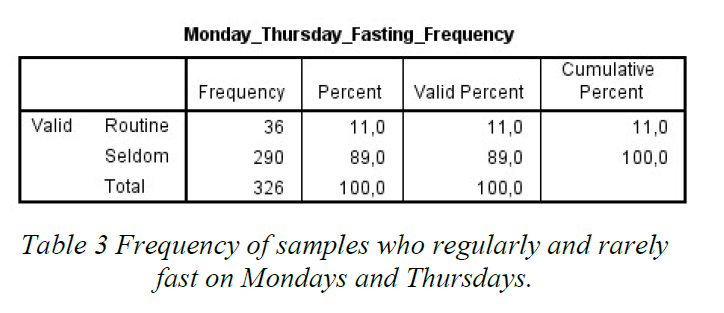
Based on table 3, it can be concluded that the students who fast regularly on Mondays andThursdaysnumbers as many as 36 students and the students who rarely fast on Mondays and Thursdays for three months numbers as as many as 290 students.
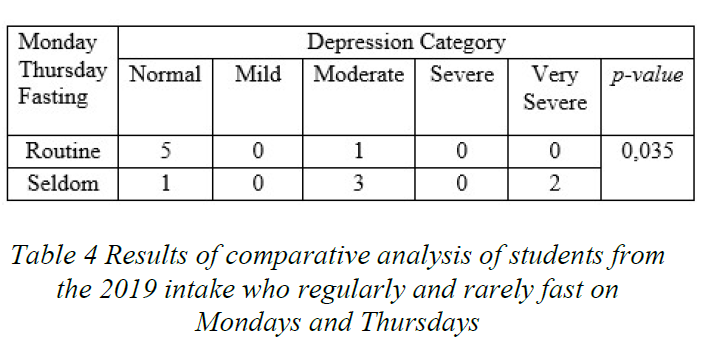
Table 4 shows a correlation between Monday-Thursday sunnah fasting three months ago and depression levels, with a p-value of 0.035. This supports the hypothesis that Monday-Thursday fasting can reduce depression levels.
And in line with research conducted by Elisa Berthelot et al., 202134 on “Fasting Interventions for Stress, Anxiety and Depressive Symptoms: A Systematic Review and MetaAnalysis” it can be concluded that it is recommended to carry out fasting interventions because there are positive effects on reducing anxiety, depression, and BMI without increasing fatigue.
In addition, researchers also found out how many students regularly do this. The study found that 36 students across three classes hadfasted on Mondays and Thursdays regularly for the past three months. The researchers then compared 36 preclinical students who had fasted on Mondays and Thursdays for less than three months. After being analyzed using the Chi Square test, the results were obtained in the following table.
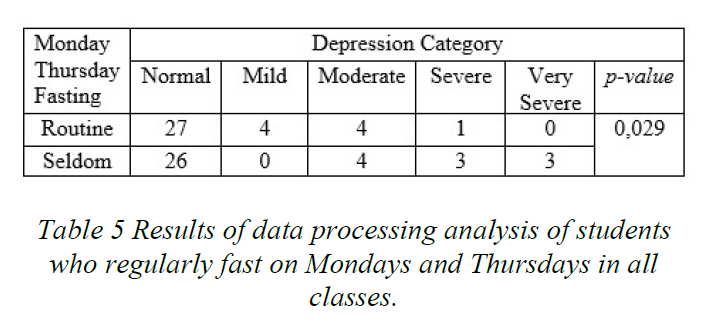
From table 5 it can be concluded that the Monday-Thursday sunnah fast was 3 months agohad an effect on the level of depression in preclinical students with a significance value of 0.029 (< 0,005) This can be concluded from the analysis results that it is meaningful.
Discussion
This study is proven to be relevant to several previous studies on the Effects of Fasting on the Physiological and Psychological Responses in Middle-Aged Men concluded that his research confirmed that there were benefits to the factors physiological aspects of the body (Krzysztof, 2023). This aligns with the Prophet’s hadith, which states, “Fast and you will be healthy” (Narrated by Bukhari). Health, in this context, can refer to both physical and spiritual health. Numerous studies have examined the effects of fasting on body mass index, blood sugar levels, cholesterol, and blood pressure. Physiologically, when blood sugar drops during fasting, the pancreas increases glucagon secretion, which also lowers blood insulin levels. In this study, after reducing the sample size, a significant correlation was found between the effects of Monday-Thursday fasting on depression in medical students at the Faculty of Medicine, UIN Syarif Hidayatullah.
Conclusion
A conclusion of this study, there is a significant relationship between Monday-Thursday fasting and depression levels.
Limitation and Suggestion
This research was conducted internally at UIN Syarif Hidayatullah, so the sample was homogeneous and not representative of the general population. This study aimed to determine whether fasting on Mondays and Thursdays can reduce depression levels. However, research on the factors that influence this is still lacking. Reducing depression levels has not been proven. Therefore, factors that can reduce depression levels in preclinical students are unknown. The large number of questions in the questionnaire made it time-consuming to complete. This study did not include data on subjects currently taking depression medication, which could potentially introduce bias.
References
1. Research and Development Agency. (2018). 2018 National RISKESDAS Report. Health Research and Development Agency)
2. Muslim, Sahih Translation. Sahih Muslim. Study of the Book of Hadith: From Muwattha Imam Malik to Mustadrak Al Hakim. 2020
3. Amin, A., Sai, S.K., Mishra, S., Reddy, U.K., N., S., &Mukkadan, J.K. (2016). Effects of fasting during Ramadan month on depression, anxiety and stress and cognition. Prog Neurobiol.; 88(1): 17-31 15. Saldanha D, Kumar N, Ryali V, Srivastava K, Pawar AA.
4. Mousavi, S. A., Rezaei, M., Baghni, S. A., & Seifi, M. (2014). Effect of Fasting on Mental Health in the General Population of Kermanshah
5. Ridho, S., Hasan, H., AK, A., Futihandayani, A., Islamiati, D., &Suralaga, F. (2021). The Relation between Monday and Thursday Fasting towards Emotional Intelligence (EI): A Preliminary Report. 12(04). https://doi.org/10.4108/eai.20-10-2020.2305136
6. RosyatiLilin, et al. (2018). Understanding Major Depressive Disorder: A Psychoneuroimmunological Approach to the Study of Cytokines, Tryptophan, and the HPA Axis. Kendari Health Polytechnic.
7. Ai-Min Bao et al. The Human Hypothalamus in Mood Disorders : The HPA Axis in the CenterZhejiang University School of Medicine. China. 2019
8. P, G., & J, G. (2003). Entrapment and arrested fight and flight in depression: an exploration using focus groups. Psychology and psychotherapy, 76(Pt 2), 173–188. https://doi.org/ 10.1348/14760830376595120350
9. Sadock VA, RP (nd). (2015) Kaplan & Sadock’s Concise Textbook of Clinical Psychiatry Philadelphia: Wolters Kluwer (4 ed.).
10. Kumar A, (2013) Rinwa P, Stress: Neurobiology, consequences and management. Journal of Pharmacy and Bioallied Science. Vol 5
11. Yang Longfei et al. (2015) The Effects of Psychological Stress on Depression. Jilin University China.
12. Fuchs Eberhard, Flugge Gabriele. (2004) Cellular Consequences of Stress and Depression. Clinical Neurobiology German Primate Center. Vol 6
13. Saldanha D, Kumar N, Ryali V, Srivastava K, Pawar AA. (2009) Serum Serotonin Abnormality in Depression. Med J Armed Forces India.;65(2):108-112. doi:10.1016/S0377-1237(09)80120-2
14. Utama H, (2013) Textbook of Psychiatry. 2nd Edition. Jakarta: FK UI Publishing Agency, 17. Hasbi TM. (1983) Fasting Guidelines. Jakarta. Bulan Bintang. 1983 18. MuschlichMaruzi, Fasting Worship Guidelines. Jakarta: Pustaka Amani.
15. Lovibond SH, Lovibond PF (1995): Manual for Depression Anxiety Stress Scales. The Psychology Foundation of Australia Inc, Australia.
16. Damanik, ED (2006): The Measurement of Reliability, Validity, Items Analysis and Normative Data of the Depression Anxiety Scale (DASS). Faculty of Psychology, University of Indonesia, Indonesia.
17. . Lovibond, P.F., & Lovibond, S.H. (1995). The Structure Of Negative Emotional States: Comparison OfThe Depression Anxiety Stress Scales (DASS) With The Beck Depression And Anxiety Inventories. In BehaP. Res. Ther (Vol. 33, Number 3)
18. EH, L., SJ, L., ST, H., SH, H., & JH, K. (2017). Reliability and Validity of the Beck Depression Inventory-II among Korean Adolescents. Investigative psychiatry, 14(1), 30–36. https://doi.org/10.4306/PI.2017.14.1.30
19. Benedetti Benedetti, A., Wu, Y., Levis, B., Wilchesky, M., Boruff, J Ioannidis, JPA, Patten, SB, Cuijpers, P., Shrier, I., Gilbody, S., Ismail, Z., McMillan, D., Mitchell, N., Ziegelstein, R. C., & Thombs, B. D. (2018). Diagnostic accuracy of the Geriatric Depression Scale-30, Geriatric Depression Scale-15, Geriatric Depression Scale-5 and Geriatric Depression Scale-4 for detecting major depression: Protocol for a systematic review and individual participant data meta-analysis. BMJ Open, 8(12), 1–6. https://doi.org/10.1136/ BMJOPEN-2018-026598
20. Berthelot E, Etchecopar-Etchart D, Thellier D, Lancon C, Boyer L, Fond G. Fasting Interventions for Stress, Anxiety, and Depressive Symptoms: A Systematic Review and Meta Analysis. Nutrients. 2021;13(11):3947. Published 2021 Nov 5. doi:10.3390/nu1311394752
21. Rhaisya, Ade Oktavia et al. The Relationship Between Tahajud Prayer and Monday Thursday Fasting with Anxiety Levels of Students of the Faculty of Medicine, Muhammadiyah University of Surakarta. Muhammadiyah University of Surakarta. 2018
